
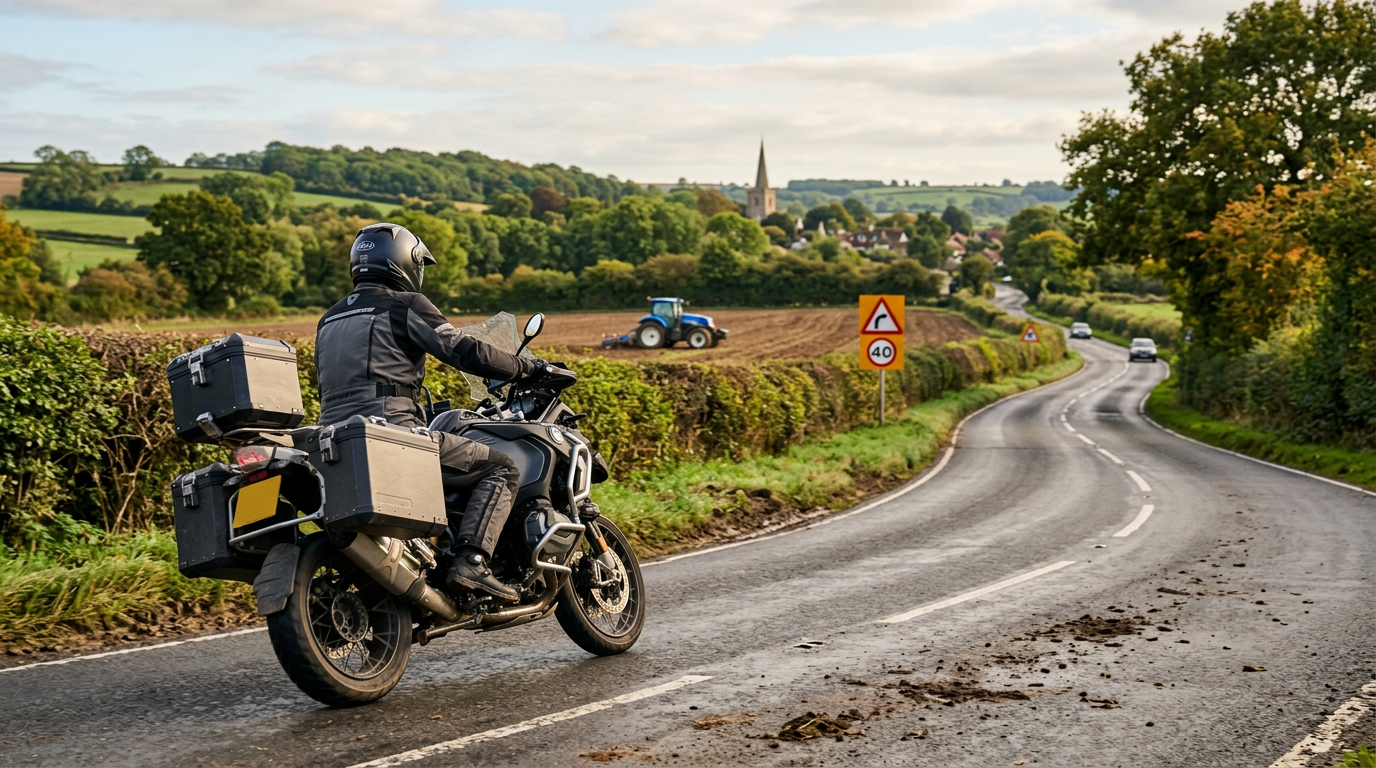
As summer gives way to autumn, the days become shorter, and the sun is seen lower in the sky. With changing light and weather conditions, September provides a good opportunity to consider how much useful information can be gained from the environment around us.
As an Advanced Rider, the road ahead should not be viewed in isolation. Observation links can be used to identify clues that may indicate what is likely to be encountered further ahead.
What can the environment tell you?
Fresh mud or debris on the road may indicate that a tractor or other agricultural vehicle is being used nearby. A church steeple, a group of buildings or increased roadside activity may indicate that a village is being approached.
Farm gates and livestock fencing can provide clues that animals or agricultural vehicles may be encountered. Parked vehicles, pedestrians and cyclists can indicate that the character of the road is about to change.
Even changes in the road surface, roadside furniture or the surrounding landscape can provide useful information.
The important point is that these observations should not simply be noticed. Their significance should be considered.
The question to be asked is:
“What is this telling me about what might happen next?”
Observation, Anticipation and Planning
This is where OAP: Observation, Anticipation and Planning becomes particularly valuable.
Through Observation, information is gathered from the road and its environment.
Through Anticipation, consideration is given to what that information might mean. If a village can be seen ahead, for example, a change in traffic, pedestrians, parked vehicles or speed limits can be anticipated.
Through Planning, an appropriate response can be prepared before the hazard is reached.
By using OAP effectively, situations can be dealt with proactively rather than being reacted to at the last moment.
Putting the information into IPSGA
The information gathered through observation and OAP can then be used within IPSGA: Information, Position, Speed, Gear and Acceleration.
For example, if fresh mud has been identified on the road approaching a bend, the possibility of a tractor or agricultural vehicle being encountered can be anticipated.
The rider’s Position can then be selected to provide the best available view while maintaining an appropriate safety margin. Speed can be adjusted if necessary, and the appropriate Gear can be selected so that the motorcycle remains under full control.
Once the potential hazard has been negotiated and the road ahead has been confirmed as clear, appropriate Acceleration can be applied and the ride can continue.
The same process can be applied when a village is identified ahead. The information provided by the environment allows the approach to be planned before the built-up area is reached, rather than waiting until the hazards are already present.
Look beyond what you can see
Good observation is not limited to identifying immediate hazards. Information is constantly being provided by the environment, and it can be used to build a picture of what may be encountered next.
When OAP is combined with IPSGA, more time is created for decisions to be made calmly and progressively. Position, speed, gear and acceleration can then be adjusted before they are needed.
This is one of the characteristics of advanced riding: the ability to anticipate what is likely to happen rather than simply react to what has already happened.
So, on your next ride, don’t just look at the road.
Read the environment.
Ask yourself:
“What is this telling me about what might happen next?”
Want to develop your advanced riding?
The principles of observation, anticipation and planning are at the heart of advanced motorcycle riding. They can be developed through practice, feedback and a better understanding of how information should be used.
Find out more about our motorcycle training and how your riding can be developed.
